Last time we talked about some of the basic divisions of the nervous system, and that knowledge is essential to addressing cognition and consciousness from a scientific perspective. Now let’s consider the neural underpinnings of a few of our everyday behaviors. Humans intentionally move through their environments, seeking goals. To accomplish that, we all, to some extent, see, hear, taste, feel, and sense our environments. Those neural processes are shaped and restricted by our genetics, development, and experience. We share the world with other animals, and have similar nervous systems, but each species cuts up the sensory world in specific ways, experiencing it in species specific ways. Phenomenology is the study of animals’ experience of the world. It is the science of the experience of objects in nature, rather than a science of those objects. The origin of that awareness, our phenomenology, and our scientific understanding of these processes is what we want to discuss.
Humans move and can target their behaviors to achieve goals. One example is eating, a behavior we share with other animals. Eating involves multiple behaviors and multiple nervous subdivisions. Eating involves motor and sensory behaviors, emotional behaviors, and social behaviors. Eating also produces a variety of internal experiences, such as flavor, enjoyment, envy, desire, and guilt. We will discuss the intricacies of our eating behavior in a future blog, which will provide us the opportunity to discuss experience, consciousness, and phenomenology in a very familiar context. Before we go there, there are a few more basics we need to cover.
This is going to get a little technical for just a bit, but a brief deep dive will give us the concepts to discuss our topics. The human body, like the bodies of all living things, is made up of cells. Cells have a protective outer membrane that allows passage of some molecules but not others. That membrane consists of phospholipids, proteins, and several organelles. Phospholipids, like all lipids, are fatty compounds, (triglycerides and cholesterols are other examples of lipids). Phospholipids have hydrophobic tails, which repel water, and hydrophilic heads, that interact with water, making them especially good at controlling the transport of water and the molecules in it. Some of those molecules have electric charges, for example a positive charge from a missing electron, called a cation, or a negative charge from an extra electron, called an anion. These ions are in the electrolytes from the foods we eat and beverages we drink. Without them, we die. The membrane creates a voltage differential between the inside and the outside of the cell, for example, the inside of an average neuron at rest has a minus 70 millivolt difference from the fluid outside the cell.
Neurons have harnessed this voltage differential to create electrochemical signals that can be sent over great distances to tiny targets. The electrical component of this signal, which we just discussed, is called an action potential – neuron firing. The other component of this signal is chemical and involves the release of neurotransmitters into the synapse. The synapse is the gap between the terminal button (the presynaptic membrane) of one neuron and the receptors on another neuron (the postsynaptic membrane).
Like the endocrine system (our glands), the nervous system can affect the body and our behavior through substances in the blood stream. These substances, for example adrenalin and norepinephrine, have lasting and cumulative effects. Unlike the endocrine system, the nervous system can affect a specific target for a measured amount of time. Action potentials from the frontal cortex of the brain travel on axons toward the center of the brain and down the brainstem to the lumbar spinal cord and signal a neuron to contract your quadriceps with a specific force for a specific time. Take some time to appreciate that the signal travels a meter from the brain down the axons, synapses onto other neurons in the ventral horn of the spinal cord and maintains enough fidelity to precisely execute the task in muscle tissue another half meter away.
Let’s look a bit closer at neurons and the neural signals. Neurons are classified by shape and function. There are over 70 described shapes of neurons. The most common shape is called a multipolar neuron. These cells have several collecting arms, called dendrites, and one or more axons extending away from the cell body. Axons can be millimeters long, for example interneurons in the spinal cord, or several feet, for example the sciatic nerves. Neurons can also be classified by the types of neurotransmitters they release at their terminal ends. Some common neurotransmitters are dopamine, serotonin, norepinephrine, acetylcholine, and glutamate.
Neural signals are not digital, restricted to binary computations of on and off, zeros and ones. Neurons have multiple states, and they can be measured. They can be at rest, they can be firing at a specific rate from stimulation, and they can spontaneously fire periodically at a specific rate. The firing rates of neurons can excited (increased from their current rate) or inhibited (decreased from their current rate), and depending on the neurotransmitters they release, they can increase or decrease the firing of other neurons.
Neurons can change the number of receptors on their receiving ends when they consistently get a specified input. A specific postsynaptic receptor, called a G-coupled protein receptor, can boost the signals they consistently receive, in essence learning to become more sensitive to specific stimulation. The expression of the neuron’s DNA is changed by experience. We know now that experience can change the expression of our DNA through a process called epigenetics. The brain is not a computer, not even a quantum computer. The brain is soft, wet, and always doing something -producing our behavior, our experience, and our consciousness of it. This happens at the ionic level, the molecular level including our DNA, the cellular level, and at the anatomical level, in the pieces and parts of our brain.
Where does experience happen? Where does consciousness happen? Or does it really happen at all? What level of scientific analysis is appropriate to understand the causes of our behavior? The flow of ions across cell membranes certainly causes our behavior. It is the proximal cause of neurons firing. As you read these words, sodium and potassium are moving across your neuron cell membranes. It seems a poor explanation for the richness of our behavior. We can focus deeper, to another level of resolution, and talk about the behavior of the subatomic particles making up those ions flowing across membranes, but this seems to me to be going the wrong way. We can pull back from that atomic level and focus on large biomolecules, for example, our DNA, and look for explanations for our behavior. We can pull back further, and look at parts of the brain, clusters of neurons working like circuits. These circuits are connected in networks, so we could pull back and look more grossly at the brain connectome. Or we can pull all the way back and look at the interaction of the brain, the environment, and social behavior to explain our behavior. Each of these levels are connected, and each contributes to our understanding. We want to be careful not to reduce our explanations to a level that cannot address the emergent properties from these interactions. More on this later.
For now, let’s move upstream from the firing of neurons to larger clusters of neurons working together. When you dissect the brain, you can us a long dull knife to cut down the longitudinal fissure and down through the corpus collosum connecting the hemispheres, and down through the brainstem and end up with two nearly identical halves. If you look on the inside of each of those halves, you will see some parts that are darker than other parts. The dark parts are layers of neuron cell bodies. The lighter parts are axons, which are coated in fat making them look paler. You can see the tracts of axons going up and down the brainstem. They look like white threads.
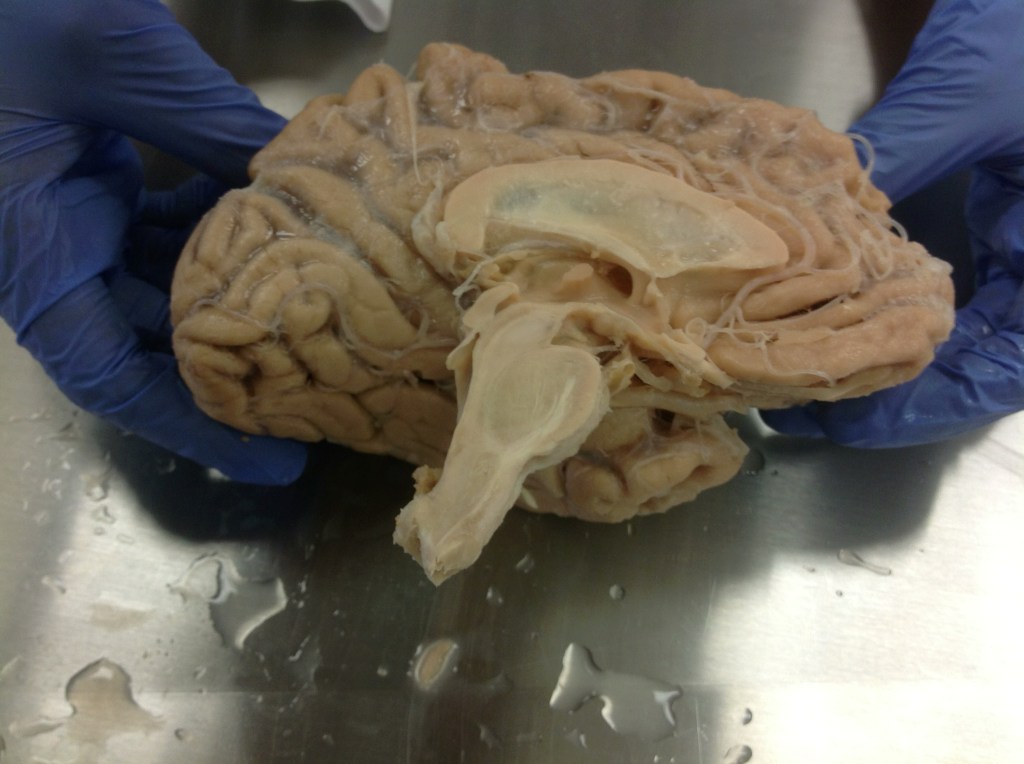
The dark areas are the cortex of the brain, for example, the motor cortex, the sensory cortex, and the visual cortex on the superior surface, and the cingulate cortex (our emotional cortex) on the medial surface. The dark areas of the brainstem are cranial nerve nuclei. The lighter area in the middle is the corpus collosum, which is a bundle of axons connecting the hemispheres. Everything that happens in one hemisphere is communicated to the other, and this takes some time. The light thread of the brainstem are tracts, for example the corticospinal motor tract. These connections and their patterns of activity produce our thinking and behavior, but we are usually not conscious of the activity of the corticospinal tract, or of the visual cortex. We are conscious of the movement and of some of the things we see. Damage to these networks of gray and white matter, and to the structures they comprise have profound effects on what we can perceive and do.
For example, damage to the visual cortex in the occipital lobe can leave a patient blind, but their eyes react to objects in the visual field. They can walk around in a complicated environment; they duck their heads when necessary. These patients can see, but they are not aware of what they see. They don’t know they can see. This cortical blindness is called blindsight. We will cover how this happens in the vision blog, and other bizarre disruptions of consciousness in subsequent blogs. Our visual perception and our waking consciousness are seamless, but from a neurological perspective, they are snapshots, thousands of samples of the environment stitched together. This has led many to believe that consciousness is an illusion, and free will a mirage. That will not stop us from looking.
In the next blog, we will look at the gray and white matter of the brain in search of our elusive ghost. We can begin by trying to find a neural structure that could be a control center. A place where all this starts.
 The HumanNervous System
Leave a comment